Two cities, one river, a hundred thermal springs

Budapest, Hungary Itinerary: 3 Perfect Days

Budapest is really two cities facing each other across the Danube, and three days is the right amount of time to get to know both. Pest, on the flat east bank, holds the Parliament, the basilica, the great market hall, the Jewish Quarter and the long riverfront promenade; Buda, on the hilly west bank, holds the castle ridge, Matthias Church, the white turrets of Fisherman's Bastion and the cave roads down to the river. Between them run four metro lines, the oldest underground railway on the European continent, and under the whole city sit the thermal springs that made it a spa town before there was a spa town — hot water surfaces at more than a hundred points, and the pools have been in continuous use since the Ottomans. This plan spends Day 1 in Pest and on the river, Day 2 up on Castle Hill and over at Gellért Hill with a bath to finish, and Day 3 along Andrássy út to Heroes' Square and the City Park pools, with the ruin bars saved for the last night. Every ticket and pass below is the current published price, and the two bookings that actually matter — the Parliament and the Matthias Church tower — are called out early.

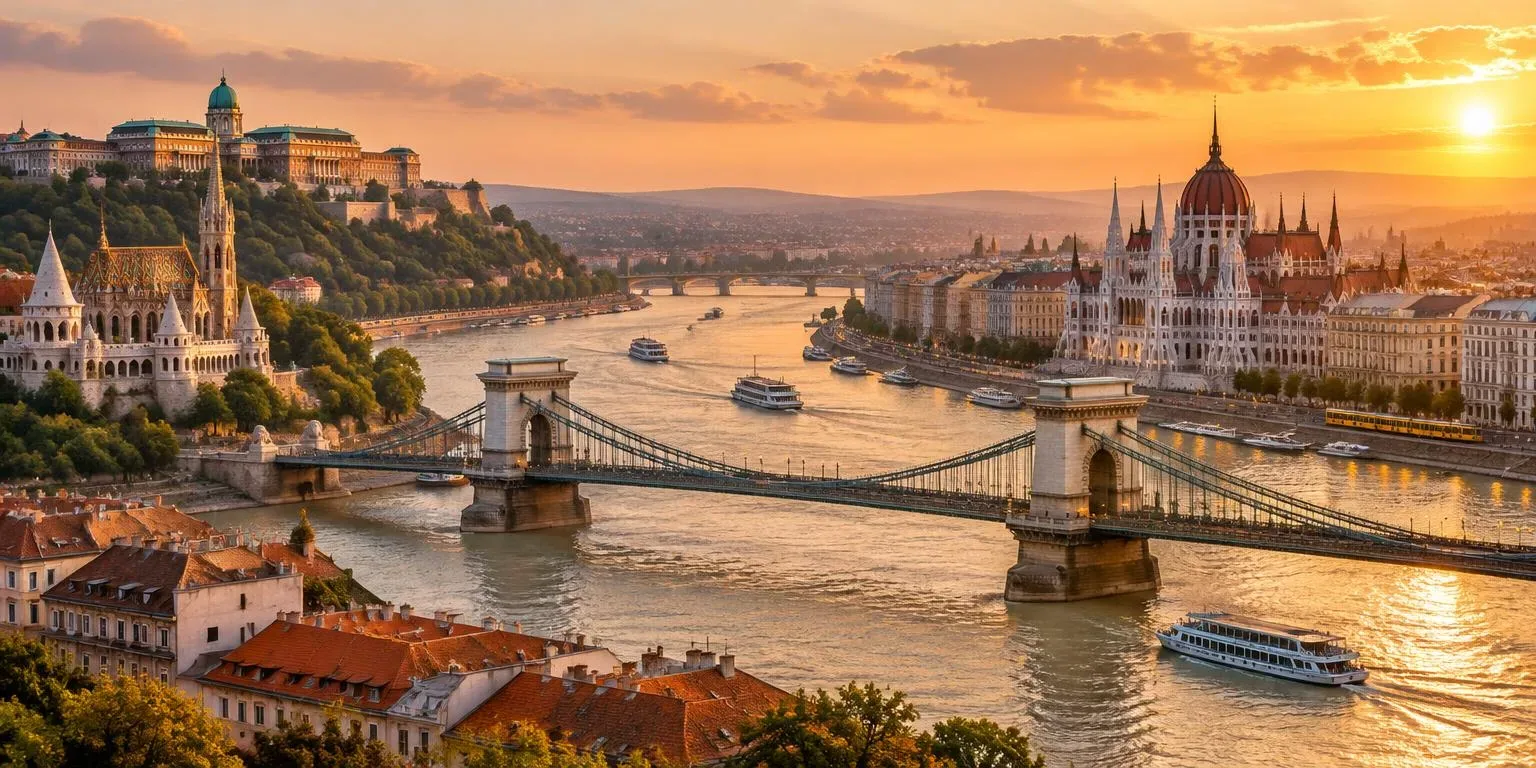
Golden-hour view north over the Danube in Budapest, Hungary, with Buda Castle, Matthias Church and the white turrets of Fisherman's Bastion on the wooded west bank, the Chain Bridge spanning the river, and the dome of the Hungarian Parliament on the Pest embankment to the right

Best time to visit

April to June and September to October bring long, dry, bright days and the terrace culture at its best. July and August are genuinely hot — highs average 28 °C and the city record is 41.6 °C, set in early August — with July the wettest month and sudden thunderstorms. Winter is cold but rarely deep (January averages 0 °C) and is the season the thermal baths were made for; the Advent fair at Vörösmarty tér runs from mid-November to New Year's Eve. Spring is the driest time of year and the Danube banks fill with cyclists by April.

Getting around

Buy tickets in the BudapestGO app before you land: a single is 500 HUF in the app but 700 from a driver or ticket desk, a block of ten is 4,500, and the 72-hour travelcard at 5,750 HUF is cheaper than three 24-hour cards at 2,750 each. One ticket covers metro M1–M4, trams, buses, trolleybuses and the HÉV suburban lines, and paper tickets must be validated before you board. The airport is not on the ordinary network: the 100E Airport Express to Deák Ferenc tér needs its own 2,500 HUF ticket, or a 1,000 HUF add-on if you already hold a pass, while the 200E to Kőbánya-Kispest takes a normal ticket. Tram 2 along the Pest embankment and the M1 down Andrássy út are the two rides worth taking for the view alone.

The 3-day Budapest, Hungary itinerary

Day 1

Pest: the Parliament, the dome and the river after dark

  1. Morning

    Parliament tour 7,000 HUF (EEA) / 14,000 HUF (non-EEA) · square and memorial free

    Inside the Parliament, then the riverbank memorials

    Start at Kossuth Square with the building itself — a 268-metre neo-Gothic façade, a 96-metre dome and one of the largest parliament houses in the world, laid out along the Pest bank so that it reads best from the water rather than from the street. The 45-minute guided visit gets you into the cupola hall, the Habsburg vault and the Holy Crown room; tickets are sold only through the official portal and are usually gone five weeks out, so book this before you book the flight. Afterwards walk down to the Danube for Shoes on the Danube Bank, sixty cast-iron pairs left on the embankment where Budapest's Jews were shot in the winter of 1944, and continue along the promenade past the Academy of Sciences toward the Chain Bridge.

    Hungarian Parliament Building, Budapest
  2. Afternoon

    Basilica terrace & treasury 5,000 HUF (all-in-one 6,800) · market free, lángos 1,500–2,500

    The basilica dome, Váci utca and the Great Market Hall

    From the Parliament it is a fifteen-minute walk to St Stephen's Basilica, Budapest's largest church and, by an old civic rule, exactly as tall as the Parliament at 96 metres — a deliberate statement that spiritual and secular power weigh the same here. The church hall is worth the small ticket for the gilded altar and the Holy Right Hand, the mummified fist of Hungary's first king, but the real payoff is the panorama terrace under the dome: 5,000 HUF, reached by lift or 364 steps, for a 360° sweep over both banks. Walk out along Váci utca to Vörösmarty tér, then five minutes south to the Great Market Hall at Fővám tér — a steel-and-Zsolnay-tiled hall from 1897 where the ground floor sells produce and paprika, the upstairs galleries sell embroidery and salami and dole out lángos with sour cream and grated cheese, and the basement is all pickles.

    Great Market Hall, Budapest
  3. Evening

    Danube cruise 5,500–9,000 HUF (free with the Budapest Card) · dinner 8,000–15,000

    An hour on the Danube as the bridges come on

    Budapest's postcard is the city seen from mid-river at the moment the floodlights come on, roughly fifteen to twenty minutes after sunset. Nearly every sightseeing boat runs the same hour-long loop between Margaret Bridge and Rákóczi Bridge from the piers at Vigadó tér, so choose the hour rather than the operator: the sunset slot gives you gold on the Parliament's stonework, the after-dark slot gives you the white-and-gold reflection the photographs promise. Come back along the embankment for dinner in District V or the Jewish Quarter, then walk into Kazinczy utca — the ruin bars are open late and take no bookings, so you can see how the night is running before committing.

    Vigadó Square, Budapest
Day 2

Buda: Castle Hill, the Bastion and the hilltop pools

  1. Morning

    Bastion terrace 1,700 HUF · Matthias Church 3,400 · National Gallery 5,800

    Up to the Castle District and the white turrets

    Cross the Chain Bridge — Hungary's first permanent span across the Danube, opened in 1849 and rebuilt stone for stone after the war — and go up the hill on bus 16 from Deák Ferenc tér, which costs an ordinary ticket, rather than the funicular at 4,500 HUF one way. The Castle District's streets, the Royal Palace courtyards and the Danube-side terraces are free at any hour; the paid things are the Hungarian National Gallery inside the palace (5,800 HUF, Gothic altarpieces and the largest collection of Hungarian art), Matthias Church at 3,400 HUF with its patterned Zsolnay-tiled roof and interior of colour, and the upper terrace of Fisherman's Bastion at 1,700 HUF — the seven neo-Romanesque turrets standing for the Magyar tribes that entered the Carpathian Basin in 896. Come before nine and you will have the terrace nearly to yourself; the lower balconies are always free.

    Fisherman's Bastion, Budapest
  2. Afternoon

    Matthias tower 4,000 HUF timed · Citadella and hill walks free

    The tower climb, then Gellért Hill for the whole city

    The Matthias Church tower is a separate 4,000 HUF ticket in timed half-hour slots and 197 steps with no lift, but the view down the Danube from its gallery is the best in the city and takes twenty minutes. Then come down through the Szent György tér vineyards — the only vineyard inside a European capital's castle district — and either walk or take bus 19/41 down to the Clark Ádám tér side and up Gellért Hill. The Citadella and the terraces below it are free, and the panorama from the top is the one every Budapest photograph steals: the river bending through the gorge, the Parliament in the distance, Margaret Island's green, and all eight bridges laid out in front of you. It is a steep climb in the sun, so go with water and go slowly.

    Gellért Hill, Budapest
  3. Evening

    Rudas 12,000–15,000 HUF (4-hour ticket 6,000–6,500) · dinner 8,000–15,000

    A thermal bath on the Buda side, then dinner in the Castle District

    Budapest sits on more than a hundred thermal springs, and the Ottoman legacy of five centuries of bathing is still the city's daily ritual. On this side of the river pick the Rudas Bath below the hill — a 16th-century Turkish dome with an octagonal pool under original stained glass, plus a rooftop pool looking straight at the Danube — at 12,000 HUF Monday to Thursday and 15,000 Friday to Sunday, with a 4-hour ticket for 6,000–6,500 and Friday and Saturday night swimming from 22:00 for 15,000. Or take the Gellért Bath for its Art Nouveau ceramic halls and wave-pool. Bring flip-flops, a towel and a small lock; the pool halls are mixed, the saunas often are not, and the water runs between 36 °C and 40 °C. Dry off and walk back up to Tárnok utca or Úri utca for dinner among the baroque houses.

    Rudas Thermal Bath, Budapest
Day 3

The Great Synagogue, Andrássy út and the City Park pools

  1. Morning

    Complex ticket covers synagogue, museum, cemetery and memorial park

    The Jewish Quarter and Europe's largest synagogue

    District VII is where Budapest's Jewish community was ghettoised in 1944 and where the city's nightlife reinvented itself sixty years later, and the two histories sit on the same streets. The Dohány Street Synagogue is the largest in Europe and the second-largest in the world by capacity, and its ticket covers the whole complex: the Moorish-Hungarian main synagogue, the Hungarian Jewish Museum, the Heroes' Temple, the graveyard, the Raoul Wallenberg memorial park and the bronze Weeping Willow whose leaves carry the names of Jews shot at the Arrow Cross camps. The free guided tour that runs through the complex is good — take it, then walk back down Dohány utca past the Kazinczy Synagogue and the old ghetto's boundary markers toward the Danube.

    Dohány Street Synagogue, Budapest
  2. Afternoon

    House of Terror 4,000 HUF · Széchenyi 13,200–14,800 HUF (early-bird 10,500)

    Andrássy út to Heroes' Square, then the great yellow bath

    Andrássy út is Budapest's answer to the Champs-Élysées, a UNESCO-listed avenue of eclectic palaces with the M1 running beneath it — opened in 1896 for the millennium of the Magyar conquest and the oldest underground railway on the European continent, still carrying small yellow trains. At number 60 is the House of Terror, 4,000 HUF, Hungary's honest museum of its two occupation regimes and the building where the Arrow Cross and then the communist secret police had their headquarters; it is closed Mondays and sells no tickets online, so buy at the door. Take the M1 to Heroes' Square and the City Park, then walk past the Vajdahunyad Castle to the Széchenyi Thermal Bath: fifteen pools, ten of them thermal, in a neo-baroque yellow palace. A weekday day ticket with locker is 13,200 HUF, 14,800 at weekends, and the Good-morning ticket — in before 9:00 — is 10,500 if you would rather bathe first and start the day late.

    Széchenyi Thermal Bath, Budapest
  3. Evening

    Free entry · half-litre beer 2,200–2,500 HUF · cocktails 4,000–5,500

    A last ruin bar and a walk back along the embankment

    For the last night, go back to District VII and the building that started the genre: Instant-Fogas, open every night from around 18:00, free at the door, several floors of mismatched rooms, a library you can drink in and a bar built inside a decommissioned tram. It is louder and larger than Szimpla Kert and fills later, which suits a final evening. Before or after, walk the Pest embankment one more time — the Parliament lit white from the water side, the Chain Bridge hung with light, Buda Castle black on the hill — and finish with a pálinka or a wine bar on Dohány utca. A night across two or three venues realistically runs 8,000–15,000 HUF a head, and several bars still take a cup deposit, so carry some cash as well as a card.

    Instant-Fogas, Budapest

What 3 days in Budapest, Hungary costs

Mid-range: a three- or four-star hotel in Districts V, VI or VII, one big thermal bath, a river cruise, two museum or palace entries a day and sit-down dinners. About HUF 96,000–186,000 (US$270–$520) for three days before flights. Dorm beds, daily lunch menus at 2,000–3,000 HUF and a single bath bring it under HUF 20,000 a day; a Danube-view hotel, a private spa session and fine dining roughly doubles it.

Estimated daily total

HUF 32,000–62,000 (about US$90–$175) per person per day

Stay (shared between two)
HUF 13,000–25,000 pp/day
Food, cafés & drinks
HUF 8,500–16,000 pp/day
Baths, museums & the river
HUF 5,500–11,000 pp/day
Transport & passes
HUF 1,500–3,000 pp/day
Buffer, tips & extras
HUF 3,500–7,000 pp/day

Budapest, Hungary weather by season

SeasonTypical range
Spring (Mar–May)2–23 °C
Summer (Jun–Aug)15–28 °C
Autumn (Sep–Nov)3–22 °C
Winter (Dec–Feb)-3–3 °C

SmartVoyage shows the live forecast, or seasonal averages for far-off dates, next to every day of a generated itinerary.

Practical tips for Budapest, Hungary

  • Book the Parliament on the official portal weeks before you fly: 7,000 HUF for EEA citizens, 14,000 for everyone else, students half, and 45 minutes inside. Slots are regularly sold out five weeks ahead, and the official site warns that tickets bought anywhere else may be overpriced, counterfeit or non-refundable.
  • Buy transport digitally and skip the daily tickets: a single is 500 HUF in the BudapestGO app but 700 bought on the spot, and the 72-hour travelcard at 5,750 HUF beats three 24-hour cards at 2,750 each. The airport needs its own 100E ticket at 2,500 HUF, or a 1,000 HUF add-on if you already hold a pass.
  • Treat the Budapest Card as arithmetic, not a default: 17,990 / 23,990 / 29,990 HUF for 24 / 48 / 72 hours buys free transport, the Lukács Bath, one Danube cruise, the Zugliget chairlift and 30-plus museums — but not the Parliament, the House of Terror, Matthias Church or Fisherman's Bastion, which are the four things most first-timers actually pay for.
  • Pay in forint and decline the exchange offer: Hungary is not in the eurozone, and a card terminal that offers to charge you in your own currency typically adds 3–5%. Use an OTP, K&H or CIB bank ATM and avoid the Euronet machines; keep some cash for the Bastion desk, market stalls and the bars that run a cup-deposit system.
  • Most of Castle Hill costs nothing: the streets, the Royal Palace courtyards and the Bastion's lower terraces are free all day, and bus 16 goes up for an ordinary ticket while the funicular charges 4,500 HUF one way and closes for scheduled maintenance on published dates. Go before nine in the morning and you can have the upper terrace almost empty.
  • Build the day around the bath's clock, not the museum's: Széchenyi's Good-morning ticket (in before 9:00) is 10,500 HUF against 13,200 for the weekday day ticket, and Rudas sells a 4-hour ticket for 6,000–6,500 against 12,000–15,000 all day. Bring flip-flops, a towel and a padlock, and go early or after 17:00 — midday is the crowd.
  • Check the closure calendar before you plan a day: the House of Terror is shut on Mondays and sells no online tickets at all, the Great Market Hall closes at 16:00 on Saturdays and Sundays and does not open on public holidays, and Matthias Church publishes its own hours day by day because services and state ceremonies take priority.
  • If you are building an evening around the floodlit riverfront, check the landmark illumination is running: Budapest switched off the decorative lighting on the Parliament, Buda Castle and the Chain Bridge for a period during the summer energy squeeze and restored it for the main monuments days later. Street lighting never went out, but the postcard view depends on a measure the city can pause again.

Budapest, Hungary itinerary questions

Is 3 days enough for Budapest?
Yes. Three days covers Pest's riverfront and market, a full day on Castle Hill with a bath, and Andrássy út, Heroes' Square and the City Park pools without rushing — and still leaves room for Margaret Island by bike or the H5 suburban train to Szentendre in about forty minutes. Add a fourth day if you want a second bath, the Museum of Fine Arts, or a slower evening pace.
When is the best time to visit Budapest?
April to June and September to October, when days are bright and dry and the riverfront terraces are open. Summer is hot — July and August average 28 °C highs, with heatwaves past 35 °C and July the wettest month — and the Parliament and sunset cruises book out. Winter is cold but cheap, January averages 0 °C, and bathing in a 38 °C outdoor pool while steam rises off it is the city's best winter activity.
Do I need to book attractions in advance?
Only two really: the Parliament, whose timed tours sell out about five weeks ahead and are sold through one official portal, and the Matthias Church tower, which uses timed half-hour slots. Sunset and after-dark cruise slots fill in summer, and most museums, baths and the Castle District are fine on arrival — though the House of Terror cannot be booked online at all.
How much does a 3-day Budapest trip cost?
Mid-range, roughly HUF 32,000–62,000 (US$90–$175) per person per day — about HUF 96,000–186,000 (US$270–$520) for three days before flights, including a central hotel, one big thermal bath, a river cruise and sit-down dinners. Dorm beds, daily lunch menus at 2,000–3,000 HUF and a single bath bring it under HUF 20,000 a day.
Is Budapest walkable, or do I need public transport?
Pest's core — the Parliament, basilica, Váci utca, market hall and Jewish Quarter — is flat and entirely walkable, but Buda's hills, Gellért Hill, the City Park baths and Margaret Island are not. The network is cheap and fast: a 72-hour travelcard is 5,750 HUF, tram 2 runs the whole Danube promenade, and the M1 runs Andrássy út to Heroes' Square.
Do I need a visa or an ETIAS to visit Hungary?
Hungary is in the Schengen area, so visitors arriving from elsewhere in Schengen face no passport control. US, UK, Canadian and Australian passport holders do not need a visa for short stays, and the EU's €20 ETIAS authorisation has been delayed again and is not required for trips before 2027. The biometric Entry/Exit System is being introduced at external borders and can add time at the airport.
Want this plan built around your dates?

SmartVoyage generates a personalized Budapest, Hungary itinerary with your budget, interests and live weather — your first one is free, no account needed.

Plan Budapest, Hungary free

More destination itineraries

3 days in New York City, United States

3 days · Manhattan & Brooklyn

3 days in San Diego, United States

3 days · Coast, park & bay

3 days in Washington, D.C., United States

3 days · Mall, museums & neighbourhoods

3 days in Austin, United States

3 days · Music, food & the springs

3 days in London, United Kingdom

3 days · Westminster, the City & South Bank

3 days in Paris, France

3 days · Paris

3 days in Dubai, United Arab Emirates

3 days · Dubai

3 days in Rome, Italy

3 days · Ancient Rome & Vatican

3 days in Tokyo, Japan

3 days · Tokyo, Japan

10 days in Costa Rica

10 days · Volcano, cloud forest & Pacific coast

3 days in Barcelona, Spain

3 days · Gaudí, Gothic & the sea

3 days in Las Vegas, United States

3 days · Strip, downtown & desert

7 days in Portugal

7 days · Lisbon, Sintra & Comporta

5 days in Chicago, United States

5 days · Loop, lakefront & neighbourhoods

3 days in Amsterdam, Netherlands

3 days · Canals, museums & neighbourhoods

3 days in Dublin, Ireland

3 days · Georgian streets, history & coastal air

3 days in Venice, Italy

3 days · Canals, Byzantine art & the lagoon islands

4 days in Bangkok, Thailand

4 days · temples, river life & street food

3 days in Kyoto, Japan

3 days · temples, bamboo & old Kyoto lanes

5 days in Bali, Indonesia

5 days · Ubud, rice terraces, temples & the Bukit

4 days in Cancún, Mexico

4 days · Hotel Zone, Chichén Itzá, cenotes & Tulum

3 days in Mexico City, Mexico

3 days · Centro Histórico, Chapultepec, Coyoacán & Teotihuacán

3 days in Santorini, Greece

3 days · Oia, Fira & the caldera

3 days in Athens, Greece

3 days · Acropolis, Plaka & the Riviera

3 days in Rio de Janeiro, Brazil

3 days · Christ the Redeemer, beaches & Sugarloaf

4 days in Istanbul, Turkey

4 days · Hagia Sophia, the Bosphorus & the bazaars

3 days in Miami, United States

3 days · South Beach, Wynwood & Calle Ocho

4 days in Maui, United States

4 days · Haleakala, Road to Hana & West Maui

3 days in Prague, Czech Republic

3 days · castles, bridges & spires

5 days in Reykjavik & the Ring Road, Iceland

5 days · waterfalls, glaciers & black sand

3 days in Marrakech, Morocco

3 days · medina, gardens & Atlas views

4 days in Seoul, South Korea

4 days · palaces, markets & neon nights

6 days in Ho Chi Minh City & Hoi An, Vietnam

6 days · Saigon energy & lantern-lit Hoi An

3 days in San Francisco, United States

3 days · Fog, bridges & neighborhood wandering

3 days in Portland, United States

3 days · Roses, bridges & food carts

5 days in Phuket & Krabi, Thailand

5 days · Limestone islands, beaches & longtail boats

3 days in Hong Kong, China

3 days · Skyline, dim sum & island trails

5 days in Bora Bora & Tahiti, French Polynesia

5 days · Lagoons, motus & overwater dreaming

4 days in Sydney, Australia

4 days · Harbour, beaches & the Blue Mountains

4 days in Queenstown, New Zealand

4 days · Alpine lake, adrenaline & fjords

4 days in Buenos Aires, Argentina

4 days · Tango, steak & grand avenues

7 days in Patagonia (El Calafate & Torres del Paine), Argentina & Chile

7 days · Glaciers, granite towers & two countries

5 days in Cusco & Machu Picchu, Peru

5 days · Inca citadel, Sacred Valley & high Andes

3 days in Cartagena, Colombia

3 days · Caribbean walls, plazas & island water

5 days in Cape Town, South Africa

5 days · Table Mountain, penguins & winelands

4 days in Zanzibar, Tanzania

4 days · Stone Town, spice farms & white-sand beaches

5 days in Cairo & the Nile, Egypt

5 days · Pyramids, pharaohs & the world's longest river

3 days in Florence, Italy

3 days · the Duomo, the Uffizi & Tuscany

3 days in Madrid, Spain

3 days · palaces, the Prado & day trips

3 days in Lisbon, Portugal

3 days · hills, trams & the Tagus

3 days in Vienna, Austria

Imperial Vienna in three days