Poland's old capital, small enough to cross on foot

Kraków, Poland Itinerary: 3 Perfect Days

Kraków is the Polish city that kept its old centre whole — no wartime demolition, no ring-road surgery — and three days is the right amount of time to walk it. The Old Town is a compact grid of cobbles inside the Planty park ring, about twenty minutes across on foot: the Main Market Square, the largest medieval square in Europe, sits at the centre with the arcaded Cloth Hall in the middle and St Mary's Basilica on the north side, and the royal way runs south from the Florian Gate past the university up to Wawel Hill, where the cathedral and the royal apartments stand above the Vistula. South-east of the square lies Kazimierz, the old Jewish quarter of synagogues and narrow streets that has become the city's restaurant and club district. Under the square itself is a museum of the buried medieval town, and twenty-five minutes away by train is the Wieliczka Salt Mine, worked for a thousand years and carved with a chapel of salt 135 metres down. This plan spends Day 1 in the Old Town and up on Wawel, Day 2 in the salt mine with Podgórze and Schindler's Factory afterwards, and Day 3 on the choice every visitor argues about — Auschwitz-Birkenau, the Tatras, or a slower third day in the city. Every ticket and fare below is the current published price, and the two bookings that genuinely sell out are called out early.

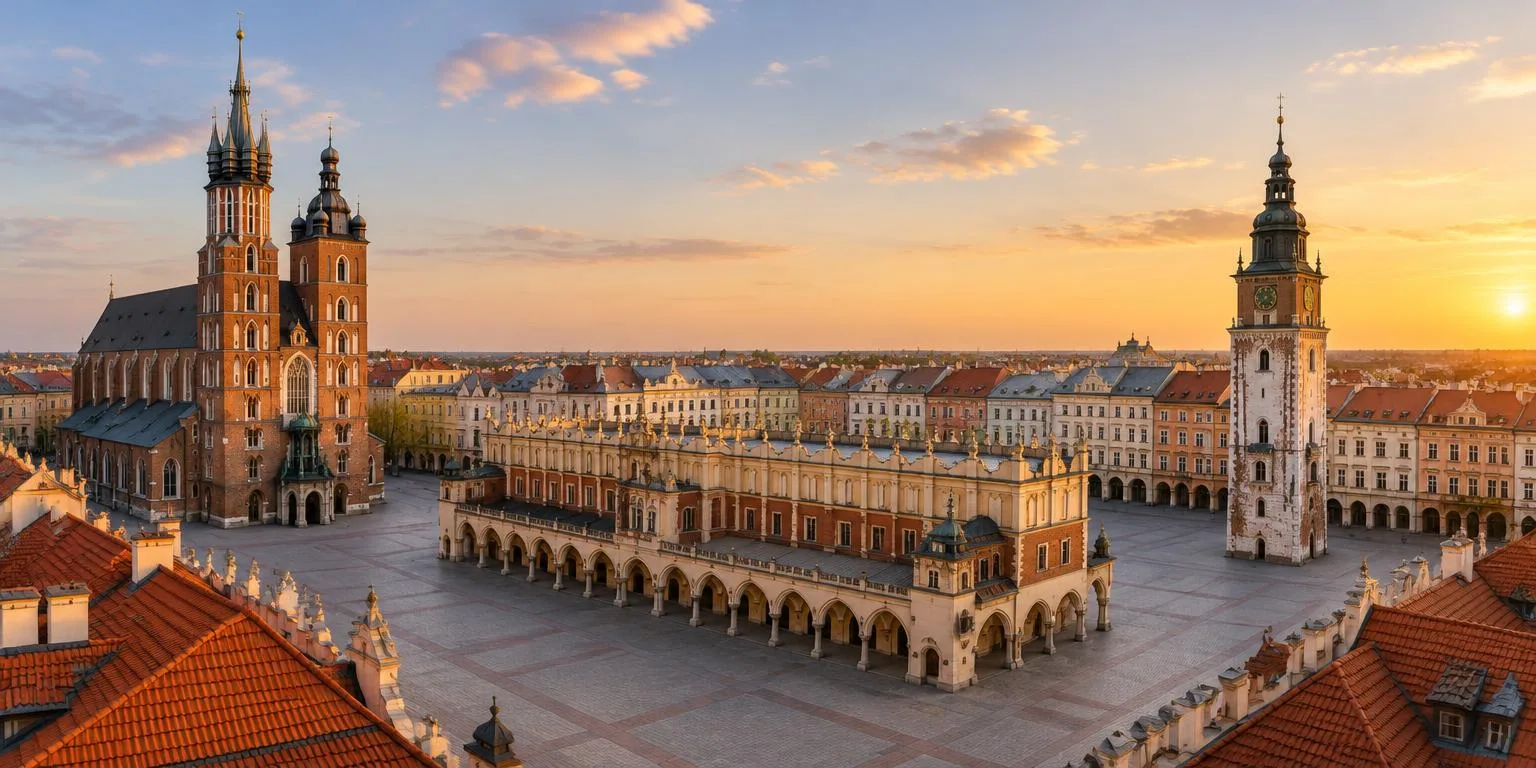
Golden-hour elevated view over Kraków's Main Market Square in Poland, with the taller Gothic spire and shorter copper helmet of St Mary's Basilica's two brick towers, the long arcade of the Cloth Hall and the freestanding Town Hall Tower above red-tiled rooftops

Best time to visit

May to June and September are the sweet spots — long, warm, dry days with the café tables out all afternoon. July and August are the warmest and busiest (highs average 26 °C, July is the wettest month, and afternoon thunderstorms come over the hills), so the mine and Wawel queue. Winter is cold and grey, January averaging near -2 °C, and cold spells trap coal smoke in the basin, so air-quality alerts are a real part of a Kraków winter. Two winter reasons to come anyway: the Advent market on the square from late November to the end of December, and November, when Wawel's paid exhibitions are free all month. Note that the Bugle Tower at St Mary's is closed from November to April.

Getting around

The Old Town, Wawel and Kazimierz are all walkable — the centre is flat and about twenty minutes across. When you do want a tram or bus, buy in the MPK app: a single ride is 6 zł, 60 minutes costs 8 zł, 90 minutes 9 zł, a 24-hour pass 20 zł and a 72-hour pass 55 zł, all valid on trams and buses across the city; paper tickets must be stamped before you set off. The airport train at Balice runs to Kraków Główny in about 18 minutes for 20 zł, and the same SKA1 line continues south-east to Wieliczka Rynek-Kopalnia — a single train ticket from the main station is 7 zł, and the same 7 zł buys a 70-minute combined ticket that also covers city trams and buses, which is the cheapest way to do the mine. App ride-hailing across the centre usually lands at 15–30 zł. Auschwitz-Birkenau is 70 km west: about an hour and a half by bus or train from the main station, or a guided minibus from your hotel.

The 3-day Kraków, Poland itinerary

Day 1

The square, the cathedral hill and Kazimierz after dark

  1. Morning

    square free · basilica interior 20 zł · Bugle Tower 20 zł (May–Oct, day tickets only)

    The Main Market Square, the Cloth Hall and the hourly trumpet

    Start on the Rynek Główny before the day groups arrive — some 40,000 m² of medieval square, the largest in Europe, with the low arcaded Cloth Hall running down the middle, the little Church of St Adalbert and the lone Town Hall Tower at its edges. Stand there on the hour and you will hear the hejnał, the trumpet signal played from the taller of St Mary's two unequal towers that breaks off mid-note each time, following the legend of a watchman shot through the throat. The Cloth Hall's upper gallery holds a fine collection of Polish painting and the ground-floor arcade is where you buy amber; then walk out through the Florian Gate and follow the royal way south past St Florian's and the university toward the hill.

    Main Market Square, Kraków
  2. Afternoon

    cathedral, tombs & Sigismund Bell free · Apartments 49 zł · Treasury 43 zł · Armoury 47 zł

    Wawel Hill: the cathedral, the royal tombs and the apartments

    Twenty minutes' walk south brings you up to Wawel, the hill that was the seat of Polish kings for centuries and still reads as the country's spiritual address. The cathedral is free — the Royal Castle does not sell tickets to it — and inside are the royal tombs and the Sigismund Bell, which you can climb to and touch the rope of. The paid exhibitions are sold separately and priced individually: the Royal Private Apartments 49 zł, the Crown Treasury 43 zł and the Armoury 47 zł, and in November all of them are free. Give the hill three hours, then come down the far side past the Dragon's Den, where the sculpture on the rock breathes real fire every few minutes for the children waiting below.

    Wawel Royal Castle, Kraków
  3. Evening

    streets free · Old Synagogue & Remuh small tickets · dinner 45–90 zł

    Kazimierz: synagogue streets, then dinner and a late club

    Cross the street at the Old Town's south edge and you are in Kazimierz, the old Jewish quarter whose seven synagogues, Remuh cemetery and cobbled lanes survived the war intact. The Old Synagogue and the cemetery take small tickets and close early, so see them by day and come back after dark, when Szeroka and the lanes off it fill with restaurants and the small clubs on Miodowa, Józef and Wschowa start filling after ten and run past two. It is the best evening in the city and the shortest walk from the Old Town — the streets are narrow, lit and busy all night.

    Kazimierz, Kraków
Day 2

A thousand years down, then the river

  1. Morning

    train 7 zł each way · Tourist Route from 121 zł

    The Wieliczka Salt Mine

    Take the SKA1 train from Kraków Główny to Wieliczka Rynek-Kopalnia — about 25 minutes, 7 zł, and the combined ticket covers the trams as well. The mine has been worked continuously from the Middle Ages into the twentieth century, and the tourist route is 3.5 km with roughly 800 steps down and back up, so wear shoes with grip; it holds 17–18 °C all year. You pass underground lakes, chapels carved by miners out of solid rock salt and, at the end, St Kinga's chapel — a cathedral-sized chamber with chandeliers spun from salt crystals. Two to three hours with an audio guide. Tickets are timed and the mine lists the tourist route from 121 zł, so book the slot before you fly.

    Wieliczka Salt Mine, Wieliczka
  2. Afternoon

    60 zł normal / 45 zł reduced · includes Eagle Pharmacy & Pomorska Street for 7 days

    Schindler's Factory and Podgórze, across the river

    Back in the city, cross the Vistula to Podgórze and the enamel factory at Lipowa 4 that Oskar Schindler ran, and whose lists saved 1,100 Jewish workers. The Museum of Kraków's exhibition there, Kraków — Time of Occupation, is one of the best museum displays in Poland: reconstructed streets, a period pharmacy, archives and the story told from the city's point of view. A normal ticket is 60 zł and also admits the Eagle Pharmacy on the square and the Pomorska Street branch within seven days. Mondays are free but the hours are short (10:00–15:00) and the first Tuesday of each month is closed. Give it two hours, then walk up to Krakus Mound for the view back over the river.

    Oskar Schindler's Enamel Factory, Kraków
  3. Evening

    free walk · milk-bar dinner 20–35 zł, sit-down 50–100 zł

    The Vistula boulevards, then the square after dark

    Walk back along the river — the Wawel boulevards have long benches, kayaks on the water and the castle lit from below — and come up through the Planty into the Main Square at night, when the crowds thin, the Cloth Hall arcades light up and the pigeons have gone home. Dinner in the Old Town, or back in Kazimierz. A bar mleczny, the old milk bar, is the cheap local canteen for pierogi, a cutlet and a kompot, and in summer the square's café tables run late.

    Vistula Boulevards, Kraków
Day 3

The day trip everyone argues about — or a slower Kraków

  1. Morning

    entry free, card booked online · guided tour 140 zł Polish / 150 zł other languages · transport 20–35 zł

    Auschwitz-Birkenau, or the alternative you would rather have

    Most three-day visits spend the last morning on the 70 km run west to Auschwitz-Birkenau, and it is the weightiest part of the trip. Entry is free, but the personalised entry card must be booked online at visit.auschwitz.org and none are issued at the gate; a guided tour with an educator costs 140 zł in Polish or 150 zł in other languages and lasts about three and a half hours. Go early, allow 30 minutes for security, and note the bag limit of 35×25×15 cm — leave anything bigger at the hotel. If you would rather not, or are travelling with children, the alternatives are the Tatras and Zakopane (about two hours by train or bus), Tyniec Abbey on the forested rocks above the river, or Ojców National Park's limestone gates.

    Auschwitz-Birkenau Memorial, Oświęcim
  2. Afternoon

    timed ticket (Museum of Kraków) · National Museum & Collegium Maius sold separately

    Under the square, or the museum you skipped

    Come back to the city for the piece most visitors walk straight over: the exhibition under the Main Market Square, built on the excavated foundations of the medieval town, where you walk on glass above twelfth-century stalls and see how deep the square actually goes. It is a Museum of Kraków branch with timed tickets. Or use the afternoon for what Days 1 and 2 pushed out — the National Museum's Lady with an Ermine, the Collegium Maius museum of one of Europe's oldest universities, or a second pass round Wawel if the first was only the cathedral.

    Rynek Underground Museum, Kraków
  3. Evening

    free · last dinner 50–110 zł

    A last lap of the Old Town

    Finish with the walk you have been doing all week but slower: the Planty ring in the evening light, the Florian Gate, one last coffee under the Cloth Hall arcade. If you are here between May and October, the Bugle Tower takes its last group up around 17:30, so save it for an afternoon slot rather than the end of the day. Kazimierz for the last night is the usual answer — dinner on Szeroka or Miodowa, then a drink in one of the small clubs that keep the quarter loud until two.

    Planty Park, Kraków

What 3 days in Kraków, Poland costs

Mid-range: a three- or four-star hotel inside the Planty ring shared between two people, one big ticketed sight a day, sit-down dinners and a night out in Kazimierz. About PLN 900–1,830 (US$225–$450) for three days before flights. A hostel bed, milk-bar pierogi and a single museum push it under PLN 200 a day; a river-view hotel, private guides and fine dining roughly doubles it.

Estimated daily total

PLN 300–610 (about US$75–$155) per person per day

Stay (shared between two)
PLN 120–250 pp/day
Food, cafés & drinks
PLN 80–150 pp/day
Museums, the mine & the towers
PLN 60–120 pp/day
Transport & passes
PLN 12–30 pp/day
Buffer, tips & extras
PLN 28–60 pp/day

Kraków, Poland weather by season

SeasonTypical range
Spring (Mar–May)0–21 °C
Summer (Jun–Aug)13–26 °C
Autumn (Sep–Nov)3–19 °C
Winter (Dec–Feb)-5–2 °C

SmartVoyage shows the live forecast, or seasonal averages for far-off dates, next to every day of a generated itinerary.

Practical tips for Kraków, Poland

  • Book the two things that actually sell out: Auschwitz entry cards are released 90 days ahead and only online at visit.auschwitz.org, with nothing issued at the gate, and Wieliczka's timed tourist-route slots go first in high season. Wawel's paid exhibitions and most museums are fine on arrival in an ordinary week.
  • The Bugle Tower at St Mary's is closed from November to April, and in season it sells 20 zł tickets at the visitor desk on the day only — no booking, groups of 15, 239 steps up. Arrive before opening or accept the queue; the tower also shuts in bad weather.
  • Wawel's cathedral, the royal tombs and the Sigismund Bell cost nothing because the Royal Castle does not sell tickets to them, while the paid exhibitions are priced separately — the Royal Private Apartments 49 zł, the Crown Treasury 43 zł, the Armoury 47 zł. All of those paid exhibitions are free through November, which makes it the cheapest museum month in Poland.
  • Stand in the square on the hour and listen: the hejnał is played from the taller tower every hour and breaks off mid-note, and the Veit Stoss altarpiece is ceremonially opened at 11:50 on weekdays and 14:10 on Sundays. The basilica opens to visitors at 11:30 (14:00 on Sundays), so do the tower in the morning and the interior after lunch.
  • Poland runs on the złoty, not the euro. Take cash from a bank ATM — PKO, Pekao or Santander — and always decline the prompt to be charged in your own currency, which adds 3–5%. Cards work almost everywhere, but the Cloth Hall stalls, market traders and some clubs want cash.
  • Buy transport in the MPK app and stamp paper tickets before you move: 6 zł a ride, 8 zł for 60 minutes, 9 zł for 90, 20 zł for 24 hours and 55 zł for 72. The 7 zł combined train-and-tram ticket is the one to know — it covers the SKA1 train out to Wieliczka and the trams at both ends.
  • Check the closure calendar before you build a day: Schindler's Factory is closed the first Tuesday of every month and on listed holidays and runs only 10:00–15:00 on Mondays (free entry that day), and the basilica is shut from Good Friday through Easter Monday. Free-admission days at Museum of Kraków branches cannot be booked in advance.
  • In a cold spell, watch the air rather than the forecast: Kraków sits in the Vistula basin, homes heat with coal and wood, and winter inversions push the air-quality index into alert territory. Check the local reading, carry a mask if you are sensitive, and put the strenuous parts — Wawel hill, the mine's 800 steps — into the warmer middle of the day.

Kraków, Poland itinerary questions

Is 3 days enough for Kraków?
Yes. Three days covers the Old Town and Wawel, a morning in the Wieliczka Salt Mine, Podgórze and Schindler's Factory, and one day trip — Auschwitz-Birkenau or the Tatras — without rushing, because the centre is only about twenty minutes across on foot. Add a fourth day if you want both Auschwitz and Zakopane, or a slower Kazimierz.
When is the best time to visit Kraków?
May to June and September: warm, long and dry, with the Bugle Tower open and the café tables out. July and August are the warmest and busiest, with 26 °C highs and afternoon storms. Winter is cold and the cheapest, and the Advent market runs to the end of December, but the tower is closed from November to April and cold spells bring air-quality alerts.
Do I need to book attractions in advance?
Two, yes. Auschwitz-Birkenau entry cards are booked online only, released 90 days ahead, with none issued at the gate, and Wieliczka's timed tourist-route tickets sell out in high season. Wawel's paid exhibitions, the Rynek Underground and the museums are normally fine on arrival — and the Bugle Tower cannot be booked at all, since tickets are sold at the desk on the day.
How much does a 3-day Kraków trip cost?
Mid-range, roughly PLN 300–610 (US$75–$155) per person per day — about PLN 900–1,830 (US$225–$450) for three days before flights, including a hotel inside the Planty ring, the salt mine, two or three museums and sit-down dinners. Hostel beds, milk-bar lunches and a single big ticket bring it under PLN 200 a day.
How do I get from the airport, and how far are Wieliczka and Auschwitz?
The airport at Balice has its own station: the SKA1 train reaches Kraków Główny in about 18 minutes for 20 zł, and the same line continues to Wieliczka Rynek-Kopalnia (7 zł from the main station). Auschwitz-Birkenau is 70 km west — around an hour and a half by bus or train from the main station, or a guided minibus from your hotel. Zakopane is roughly two hours by train or bus.
Do I need a visa or an ETIAS to visit Poland?
Poland is in the Schengen area, so travellers arriving from elsewhere in Schengen face no passport control. US, UK, Canadian and Australian passport holders do not need a visa for short stays, and the EU's €20 ETIAS authorisation has been delayed again and is not required for trips before 2027. The biometric Entry/Exit System is being introduced at external borders and can add time at Kraków-Balice.
Want this plan built around your dates?

SmartVoyage generates a personalized Kraków, Poland itinerary with your budget, interests and live weather — your first one is free, no account needed.

Plan Kraków, Poland free

More destination itineraries

3 days in New York City, United States

3 days · Manhattan & Brooklyn

3 days in San Diego, United States

3 days · Coast, park & bay

3 days in Washington, D.C., United States

3 days · Mall, museums & neighbourhoods

3 days in Austin, United States

3 days · Music, food & the springs

3 days in London, United Kingdom

3 days · Westminster, the City & South Bank

3 days in Paris, France

3 days · Paris

3 days in Dubai, United Arab Emirates

3 days · Dubai

3 days in Rome, Italy

3 days · Ancient Rome & Vatican

3 days in Tokyo, Japan

3 days · Tokyo, Japan

10 days in Costa Rica

10 days · Volcano, cloud forest & Pacific coast

3 days in Barcelona, Spain

3 days · Gaudí, Gothic & the sea

3 days in Las Vegas, United States

3 days · Strip, downtown & desert

7 days in Portugal

7 days · Lisbon, Sintra & Comporta

5 days in Chicago, United States

5 days · Loop, lakefront & neighbourhoods

3 days in Amsterdam, Netherlands

3 days · Canals, museums & neighbourhoods

3 days in Dublin, Ireland

3 days · Georgian streets, history & coastal air

3 days in Venice, Italy

3 days · Canals, Byzantine art & the lagoon islands

4 days in Bangkok, Thailand

4 days · temples, river life & street food

3 days in Kyoto, Japan

3 days · temples, bamboo & old Kyoto lanes

5 days in Bali, Indonesia

5 days · Ubud, rice terraces, temples & the Bukit

4 days in Cancún, Mexico

4 days · Hotel Zone, Chichén Itzá, cenotes & Tulum

3 days in Mexico City, Mexico

3 days · Centro Histórico, Chapultepec, Coyoacán & Teotihuacán

3 days in Santorini, Greece

3 days · Oia, Fira & the caldera

3 days in Athens, Greece

3 days · Acropolis, Plaka & the Riviera

3 days in Rio de Janeiro, Brazil

3 days · Christ the Redeemer, beaches & Sugarloaf

4 days in Istanbul, Turkey

4 days · Hagia Sophia, the Bosphorus & the bazaars

3 days in Miami, United States

3 days · South Beach, Wynwood & Calle Ocho

4 days in Maui, United States

4 days · Haleakala, Road to Hana & West Maui

3 days in Prague, Czech Republic

3 days · castles, bridges & spires

5 days in Reykjavik & the Ring Road, Iceland

5 days · waterfalls, glaciers & black sand

3 days in Marrakech, Morocco

3 days · medina, gardens & Atlas views

4 days in Seoul, South Korea

4 days · palaces, markets & neon nights

6 days in Ho Chi Minh City & Hoi An, Vietnam

6 days · Saigon energy & lantern-lit Hoi An

3 days in San Francisco, United States

3 days · Fog, bridges & neighborhood wandering

3 days in Portland, United States

3 days · Roses, bridges & food carts

5 days in Phuket & Krabi, Thailand

5 days · Limestone islands, beaches & longtail boats

3 days in Hong Kong, China

3 days · Skyline, dim sum & island trails

5 days in Bora Bora & Tahiti, French Polynesia

5 days · Lagoons, motus & overwater dreaming

4 days in Sydney, Australia

4 days · Harbour, beaches & the Blue Mountains

4 days in Queenstown, New Zealand

4 days · Alpine lake, adrenaline & fjords

4 days in Buenos Aires, Argentina

4 days · Tango, steak & grand avenues

7 days in Patagonia (El Calafate & Torres del Paine), Argentina & Chile

7 days · Glaciers, granite towers & two countries

5 days in Cusco & Machu Picchu, Peru

5 days · Inca citadel, Sacred Valley & high Andes

3 days in Cartagena, Colombia

3 days · Caribbean walls, plazas & island water

5 days in Cape Town, South Africa

5 days · Table Mountain, penguins & winelands

4 days in Zanzibar, Tanzania

4 days · Stone Town, spice farms & white-sand beaches

5 days in Cairo & the Nile, Egypt

5 days · Pyramids, pharaohs & the world's longest river

3 days in Florence, Italy

3 days · the Duomo, the Uffizi & Tuscany

3 days in Madrid, Spain

3 days · palaces, the Prado & day trips

3 days in Lisbon, Portugal

3 days · hills, trams & the Tagus

3 days in Vienna, Austria

Imperial Vienna in three days

3 days in Budapest, Hungary

Two cities, one river, a hundred thermal springs